

The Marvaco Pesach Program in Marrakesh: What Went Wrong, and What It Means for Kosher Travelers
Every so often, a Pesach program story comes along that reverberates through the entire kosher travel community, not in the celebratory way, but in the way that makes people take a step back and ask whether the industry needs a reckoning. This year, that story is the Marvaco Pesach Program 2026 in Marrakesh, Morocco. If you have been anywhere near Jewish social media in the past week, you have already seen the videos, the testimonials, and the heated debates. For those who haven’t, buckle up.
We cover Pesach programs at KosherSquared, and you can find our holiday listings here and our dedicated Passover listings here. We also published an overview of Pesach 2026 hotel programs earlier this year. This is not a story we take pleasure in writing. But the volume of credible accounts, from guests, influencers, and commentators, makes this one of the most significant Pesach program controversies in recent memory, and the kosher public deserves a thorough accounting.
What Was Promised


The Marvaco Pesach Program, operated under the name Marvaco Tours, was marketed aggressively as a luxury Pesach experience at the Zephyr Targa Hotel in Marrakesh. Advertising on PassoverListings.com described five-star dining, top-tier kosher accommodations under Beit Yosef supervision, a 24/7 tea room, programming for the whole family, and gourmet cuisine prepared by Chef Itzik Cohen. Families paid anywhere from roughly $10,000 to over $20,000 for the privilege. One Facebook commenter put it bluntly: “It was hell. And it was almost $20,000 for 6 people.”
That is a staggering amount of money for any vacation, and a staggering amount to lose if things go wrong.
What Actually Happened
By all accounts, and the accounts have been numerous and remarkably consistent, what guests encountered bore almost no resemblance to what was sold. The complaints that dominated social media during and after the program fell into several categories.
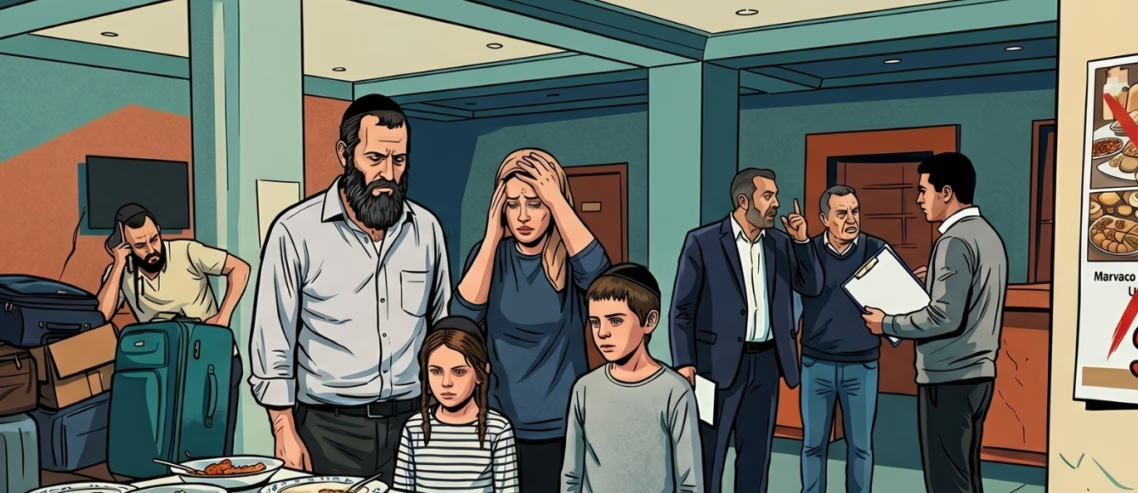
The most alarming issue, given the specific nature of Pesach, was the absence of matzah on the first night of the holiday. Matzah is not a luxury item on Passover; it is a religious obligation, and its absence at the Seder left guests in an impossible position. Grape juice was also reportedly missing or in critically short supply, meaning children or those who cannot drink wine were unable to participate in the Seder at all. The promised 24/7 tea room was reportedly shuttered for the first two to three days of the program. Food was scarce, and when it did appear, the conditions at the buffet were described as chaotic.
Instagram personality Faye Bubby, who candidly shared her experience online, described actively asking fellow guests if they planned to eat the food on their plates because she was hungry. She described hunting for chicken and meat throughout the hotel and called the entire dining situation a “disorganized mess.” Batya Reyz (@makeupbybatya), a makeup artist who attended with attorney Ben Lockspeiser (her husband) and his in-laws, described guests passing a single bottle opener around the hotel because the program had only provided one, food that was neither hot nor fresh, and no utensils at stations, guests had to separately track down a waiter, most of whom did not speak English. Sarah Guige, who brought her in-laws on what was meant to be a special experience, described feeling “drained beyond words” and said the program left basic needs unmet at a moment when being a breastfeeding mother made that especially difficult.
An Instagram user named nojobjosh described the dining room as “straight chaos,” alleging physical pushing and shoving over food, and claimed he witnessed something that shocked observers even more than the logistics failures: what appeared to be fresh pita bread openly displayed in the kitchen during Pesach. Videos circulating on social media were said to show the same. If accurate, this is not merely a matter of disorganization; it raises serious kashrus questions that go to the heart of what guests were paying for.
A Two-Tiered System
Multiple guests reported what amounts to a disturbing favoritism dynamic: the organizers’ friends, family, and inner circle, referred to by Ben Lockspeiser in his interview with Zev Brenner as the “preferred” guests or “preferred” tables, allegedly had adequate food and matza, while full-paying guests were left to go without. Ben gave a pointed and concrete example that illustrates just how brazen this arrangement was: when he asked a waiter for schnitzel for his child, he was flatly told there was none available. Moments later, he watched that same schnitzel being carried out and served to the preferred tables. This was not an isolated anecdote but part of a pattern that guests described repeatedly, a system operating in plain sight, in which two classes of guests coexisted at a program everyone had ostensibly paid to attend.
This is perhaps the most damning allegation of all, and one that is difficult to explain away as a pure logistics failure. It speaks to a prioritization that would be troubling in any context, but is particularly jarring in the setting of a Yom Tov program built around communal eating, celebration, and the equality of the holiday table.
The scarcity also produced visible, embarrassing dynamics in front of the hotel staff. When 500 to 600 Jewish guests are visibly fighting and scrambling over food in front of a non-Jewish workforce in a Muslim-majority country, it feeds into harmful stereotypes about Jewish people that are hurtful, regardless of one’s views on the program itself. The situation created a chilul Hashem that goes beyond mere consumer dissatisfaction.
Food Safety Concerns
Beyond the shortages and the indignity of the preferential system, there were also troubling reports about the safety of the food that was served. Ben Lockspeiser reported that his brother-in-law became ill during or after the program with what appeared to be a food-related illness. He was not alone; complaints about food poisoning and gastrointestinal distress circulated among guests both during the program and in the days that followed. When families travel internationally for a Yom Tov program and are completely dependent on the program’s kitchen for every meal, food safety is not a minor footnote; it is a core obligation of the organizers, and one that by multiple accounts was not adequately met.
The Venue: Not What Was Implied
One detail that has received significant attention among those reviewing the situation is the nature of the Zephyr Targa Hotel itself. The venue is rated approximately 3.9 stars on Google (out of over 3,000 reviews) and sits on TripAdvisor with similarly modest marks. Nightly rates for the property can run under $60. To be clear, there is nothing inherently wrong with any of these facts, but they are strikingly at odds with the program’s “luxury” positioning, which implied the kind of five-star resort experience associated with top-tier programs like KMR.
The condition of the rooms compounded the frustration considerably. Guests reported black mold, bug infestations that took days to address, persistent foul odors, and rodents. But Ben Lockspeiser’s account added another layer of indignity that speaks volumes about the baseline standard of service: he described having to personally tip the housekeeping staff just to obtain fresh towels for his room. At a program charging luxury prices and marketing itself as a premium all-inclusive experience, guests should not be quietly negotiating with maids for basic linens. The presence of bugs, mold, rodents, and vermin in the rooms, combined with having to pay out of pocket for towels that should have been a baseline amenity, painted a picture of a property that was nowhere near the standard the program had promised, and an operation that was not adequately monitoring or managing the guest experience on the ground. When guests are paying $10,000 to $20,000 expecting a luxury experience, the underlying hotel property matters enormously, and by every account, this one fell catastrophically short.
Armed Guards and Restricted Movement
Attorney Ben Lockspeiser, who spoke on the Zev Brenner program about his experience, reported something that struck many listeners as extraordinary: armed guards or police at the hotel who reportedly would not permit guests to leave unless they presented a certificate of payment from the front desk. Whether this was a hotel policy, a program policy, or a Moroccan law enforcement matter is unclear, but the imagery of Jewish guests being effectively confined to a distressed program in a foreign country is deeply troubling and is a dimension of this story that deserves follow-up.
The Role of Influencers
The Marvaco program was promoted in advance by various social media influencers, including @modestfashionbychaya, who subsequently posted content acknowledging that the program did not meet expectations while pushing back on those she felt were not “looking at the good.” The comment sections on those posts told a different story, with many followers arguing that there is an affirmative responsibility to call out organizers who failed to deliver on paid promises, and that emphasizing silver linings in the face of a genuine consumer harm is not the right posture.
This raises a broader question about influencer marketing in the Pesach program space. When social media personalities promote programs to their followers and those followers spend significant money based in part on that promotion, what responsibility does the influencer bear when the program fails to deliver? It is a question the community has been debating loudly this week, and one without easy answers, but one worth asking.
Ben Lockspeiser’s Remarkable Run of Pesach Misfortune
If there is a bittersweet human interest angle to this story, it belongs to Ben Lockspeiser. The attorney was at the Marvaco Morocco program with his wife and in-laws, but Morocco was not his first encounter with a Pesach program gone wrong. He was reportedly registered for the infamous Atlantic City Pesach disaster a few years ago, which became a major story in Jewish media. He was also slated to attend a canceled Guatemala program. That any one person could be this closely connected to three Pesach program crises in a row is the kind of thing that would seem implausible in a screenplay. We wish Ben and his family a much calmer Pesach next year, though he did say he might take next year off! He also noted that the experience was a great driver of weight loss and a source of familial bonding, which shows how Ben took quite a positive spin on what is otherwise a disaster.
After the program ended, Ben and his family stayed on at the hotel for Shabbat and ordered their own food separately rather than relying on the remaining program infrastructure. He recounted witnessing a mother and daughter nearby eating from their ordered food out of what appeared to be genuine hunger, a vignette that captures the human toll of the program’s failures more pointedly than any aggregate complaint.
Not Entirely First-Timers
It would be inaccurate to characterize Marvaco as a completely inexperienced operator. According to Elan Kornblum of Great Kosher Restaurants Magazine, the people behind Marvaco had previously run a program in Tangiers that was not received as catastrophically. That context matters as this was not a fly-by-night first attempt. But the Morocco program was significantly larger, reportedly serving around 600 guests, and it appears the organizers were not prepared for the scale they had taken on. A previous smaller program not ending in disaster is not a guarantee of competence at double or triple the headcount, especially when logistical complexity increases non-linearly with scale.
The organizers attributed at least part of the chaos to a shipping container that was held up in Moroccan customs and arrived late, causing the matzah and other Pesach staples to be unavailable at the start of the holiday. While that may be a genuine logistical explanation for some of what went wrong, it does not explain the reports of inadequate food generally, the alleged two-tiered system, the food safety failures, the deplorable condition of the rooms, or the reported disrespectful response from ownership, who apparently told complaining guests they were banned from future programs, and even allegations of spitting. For guests who paid luxury prices and endured anything but, being told they are “banned” in response to grievances is not a response; it is an insult.
The Listing Problem
Strangely, at the time of writing, the program’s profile on a Passover listing website still displays a five-star rating, bizarre in the extreme given the outpouring of negative guest accounts. The listing has, however, been removed from other websites. These inconsistencies in how listing platforms handle clearly troubled programs are themselves a systemic issue that the kosher travel community should address.
The Lashon Hara Debate
No controversy in the Orthodox Jewish world would be complete without a debate about whether discussing it publicly constitutes lashon hara. This one has been no exception. Some voices have urged silence or restraint, questioning whether airing communal dirty laundry in public serves any constructive purpose. Others, including many who attended the program, have argued forcefully that when real people have spent real money and endured real harm, warning the community is not only permissible but obligatory. Halacha does, in fact, recognize the concept of to’eles, a permissible, even required, purpose served by sharing negative information, and consumer protection in a space where vulnerable families spend significant funds arguably fits within that framework.
Lessons for Kosher Travelers
We have covered Pesach program disputes before at KosherSquared, including the painful limbo of refunds following Covid-era cancellations and the initial chaos as the industry tried to navigate an unprecedented situation. The Marvaco situation is different in nature but similar in its reminder that the Pesach program industry, while often spectacular, operates in a space where consumers have significant exposure and relatively limited recourse once things go wrong.
A few practical takeaways from this episode: research the actual underlying hotel on Google and TripAdvisor before booking; look for programs with long-established track records at scale, not just a single prior event; be cautious of programs whose entire digital footprint is an Instagram page without a developed website; ask specifically about contingency plans for supply chain disruptions; and if you attend a program that falls apart, document everything immediately for potential payment disputes and/or legal action.
On that last point, do not assume your travel insurance will automatically have you covered in a situation like this. Many travel insurance policies are structured primarily around traveler illness, medical emergencies, trip cancellations due to weather, or similar unforeseen events. A program that simply fails to deliver on its promises, or worse, one that guests characterize as fraudulent or a scam, may fall outside the scope of what a standard policy covers. If you are booking an expensive Pesach program, it is worth reading your policy carefully before you go and specifically asking whether non-performance or operator failure is covered. Some premium travel insurance products do offer broader protections, including coverage for supplier default, but these are not universal and are often not the default option. Knowing what you have and what you don’t before you board the plane is far better than discovering the gap when you are trying to recover tens of thousands of dollars from abroad.
At KosherSquared, we list Passover programs because we believe the concept, done well, can be genuinely wonderful. Morocco itself is a beautiful destination with a rich Jewish history, and a well-run Pesach program there has enormous potential. But done poorly, with inadequate planning and an undersized sense of responsibility to the guests who trusted the organizers with their holiday and their money, it becomes a cautionary tale that the entire community will be discussing for years. This, unfortunately, is one of those.
The organizers of Marvaco have not issued a detailed public response as of publication.
Do you have your own experience with a Pesach program, positive or negative, that you’d like to share? Reach out to us.

Comments
Comments are disabled for this post