

 in Jewish News
Brooklyn’s Kosher Stores Under Siege: Serial Burglar Exploits Shabbat
A career criminal’s calculated targeting of Jewish businesses during holy days exposes gaps in security and criminal justice accountability.
Brooklyn’s kosher business owners are facing a disturbing reality: their religious observance has made them predictable targets for crime. Angelo Robinson, a 61-year-old career criminal with over 40 arrests and five prison stints dating back to the 1980s, stands accused of systematically burglarizing kosher grocery stores and delis and specifically timing his break-ins for Shabbat and Jewish holidays when he knows the businesses will be closed and vulnerable.
The purported pattern is as calculated as it is brazen. According to law enforcement sources, Robinson allegedly stole $30,000 from Kosher Korner in Gravesend on Yom Kippur 2024, the holiest day of the Jewish calendar. Less than a month later, on a Friday night, he reportedly broke into Jerusalem Glatt on King’s Highway, cutting alarm wires and making off with $107,000 from the store’s safe.
In both cases, security footage captured a figure in a hazmat suit and ski mask methodically dismantling security systems and spending hours working on safes. At one location, he allegedly used a sawzall to break through locks. At another, he climbed through a rooftop hatch to gain entry. As alleged, these weren’t crimes of random opportunity; they were carefully planned operations executed when perpetrators knew observant Jewish owners wouldn’t be monitoring their businesses.
Serial bandit — with 5 prison stints for burglary — keeps hitting NYC kosher stores on the Sabbath but remains free https://t.co/3xRNzLkA1p pic.twitter.com/Y1LuFHTKUF
— New York Post (@nypost) November 1, 2025
A Vulnerability That Can’t Be Ignored
“He keeps hitting Jewish stores on the Sabbath,” one disgusted store owner, who asked to be identified as Mr. Cohen, told reporters. That simple statement captures a complex problem facing the kosher business community.
Observant Jews don’t work from Friday sundown through Saturday at sunset. They don’t answer phones, check security cameras, or respond to alarm notifications during these sacred hours. It’s a fundamental aspect of Shabbat observance, and apparently, it’s also been carefully studied by at least one prolific criminal.
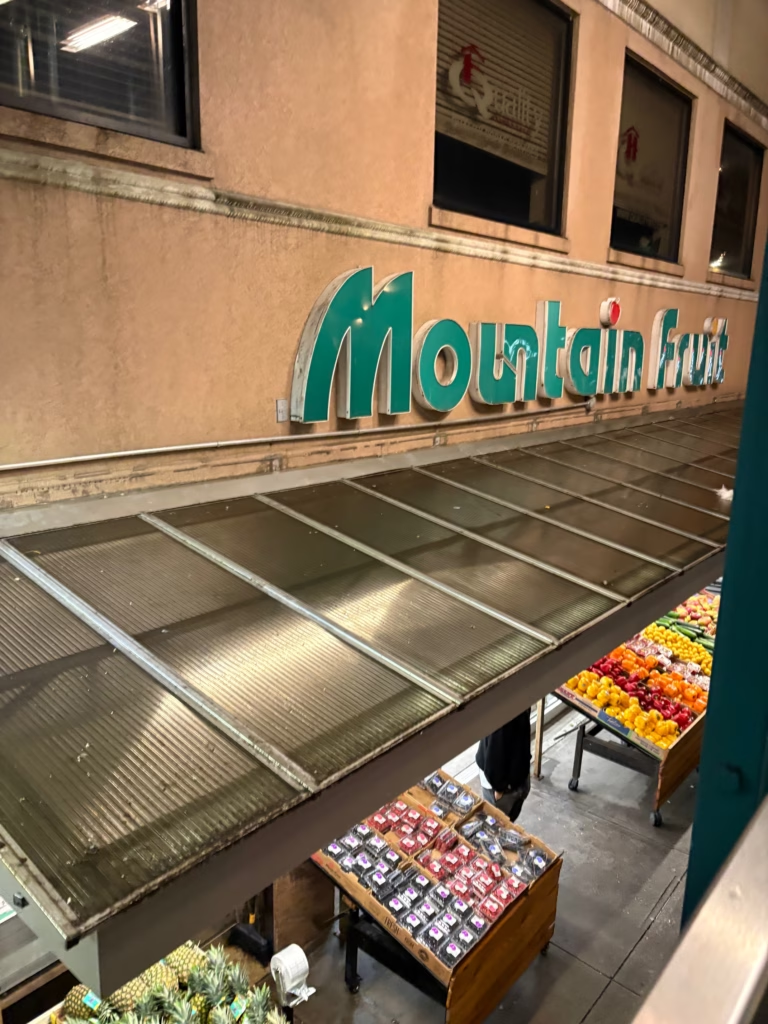
The vulnerability extends beyond Shabbat. Robinson is also suspected of a $25,000 theft at Mountain Fruit in Midwood, where the burglar reportedly spent two and a half hours working on the safe, going through multiple grinder blades. The store manager described discovering the extensive damage after the fact, evidence of how much time criminals have when they know no one will interrupt them.
The Cost Beyond Money
While the financial losses are staggering, nearly $140,000 in just the two cases Robinson was charged with in October, the psychological toll on the community may be even higher.
Cohen discovered evidence that helped identify Robinson: a Sawzall blade wrapper with fingerprints that the burglar had carelessly discarded. “I put on a pair of gloves, threw it in a Ziploc bag,” Cohen recounted. That evidence eventually led NYPD detectives to Robinson through an FBI database.
But catching the perpetrator hasn’t brought the closure or justice one might expect.
When the System Fails
Here’s where the story takes an infuriating turn that speaks to broader issues in criminal justice: Robinson was arrested on October 16, 2025, and charged with two dozen counts, including burglary, grand larceny, possession of stolen property, criminal mischief, and trespassing.
He pleaded not guilty at his arraignment.
And then he was released on his own recognizance, as per the now-infamous bail reform.
According to law enforcement sources, a critical fingerprint that identified Robinson wasn’t turned over by police to prosecutors in time to hold him, a procedural failure that allowed a man with five previous prison sentences for burglary to walk free despite being accused of stealing nearly $140,000 from kosher businesses.
Robinson’s criminal history is extensive. He served time in 1986, 1992, 2001, 2008, and 2014 for burglary and attempted burglary. Most recently, he served four years at Bare Hill Correctional Facility upstate before his release in 2023. He made headlines in 2017 for breaking into then-Brooklyn State Senator Simcha Felder’s office and tunneling through the wall into Mechy’s Gourmet, where he allegedly stole $5,000.
Despite this record, despite the evidence, despite the clear pattern of targeting the Jewish community during our most sacred times, he remains free. The investigation into other recent break-ins linked to him continues, but for now, Brooklyn’s kosher business owners are left wondering if he’ll strike again.
What Can Be Done?
The situation raises difficult questions for the kosher business community:
Enhanced Security Measures
Many kosher businesses have basic alarm systems, but Robinson’s methods show these aren’t enough. He cut alarm wires, spent hours on safes, and used sophisticated tools. Business owners may need to consider:
- Advanced alarm systems with cellular backup that can’t be disabled by cutting wires
- Time-delayed safes that prevent immediate access even if opened
- Remote monitoring services staffed by non-Jewish employees who can respond during Shabbat
- Reinforced entry points to slow down break-in attempts
- Dummy cameras and safes to waste criminals’ time
- Community watch networks that share information about suspicious activity
While certain tasks are forbidden for Jews on Shabbat, in the modern context, this might mean hiring security monitoring services or having trusted non-Jewish employees or partners who can respond to emergencies.
Some kosher businesses have already implemented this approach, contracting with 24/7 security companies that include Shabbat coverage. While this doesn’t prevent break-ins, it can dramatically reduce the time criminals have to operate.
Keeping Less Cash On-Site
One pattern is clear: these burglaries targeted cash-heavy businesses. Robinson allegedly spent two and a half hours grinding through a safe at Mountain Fruit. That kind of effort only makes sense if there’s a substantial payoff.
Kosher businesses that traditionally deal heavily in cash might need to reconsider this approach. More frequent bank deposits, daily cash pickups, or transitioning toward more card and digital payment options could make stores less attractive targets.
The Broader Picture
The kosher food industry operates on already-thin margins. Premium ingredients, kosher supervision costs, specialized processing—it all adds up. When a business loses $30,000 or $107,000 in a single night, it’s not just an inconvenience. It can threaten the viability of the entire operation. Insurance doesn’t always cover everything, and premiums rise after claims.
These aren’t just statistics—they’re family businesses, often multi-generational operations that serve as anchors in Jewish neighborhoods. When they’re targeted, the entire community feels less secure.
Moving Forward
Angelo Robinson’s case remains active. Investigators believe he may be connected to other recent burglaries in Brooklyn. His methods—rooftop entries, prolonged safe break-ins, elaborate disguises—have been well-documented on security footage.
But whether he’ll face meaningful consequences remains to be seen.
In the meantime, Brooklyn’s kosher business owners are left to implement whatever security measures they can afford, coordinate with each other, and hope that next Shabbat they’ll return to find their stores intact.
What security measures has your kosher business implemented for Shabbat and holidays? Have you experienced similar targeting? Share your thoughts and experiences.
Note: If you have information about these or related crimes, contact the NYPD’s Crime Stoppers Hotline at 1-800-577-TIPS (8477).
