
 in Kosher Buzz
Reese’s Pieces Just Went Non-Dairy Pareve and It’s a Bigger Deal Than You Think
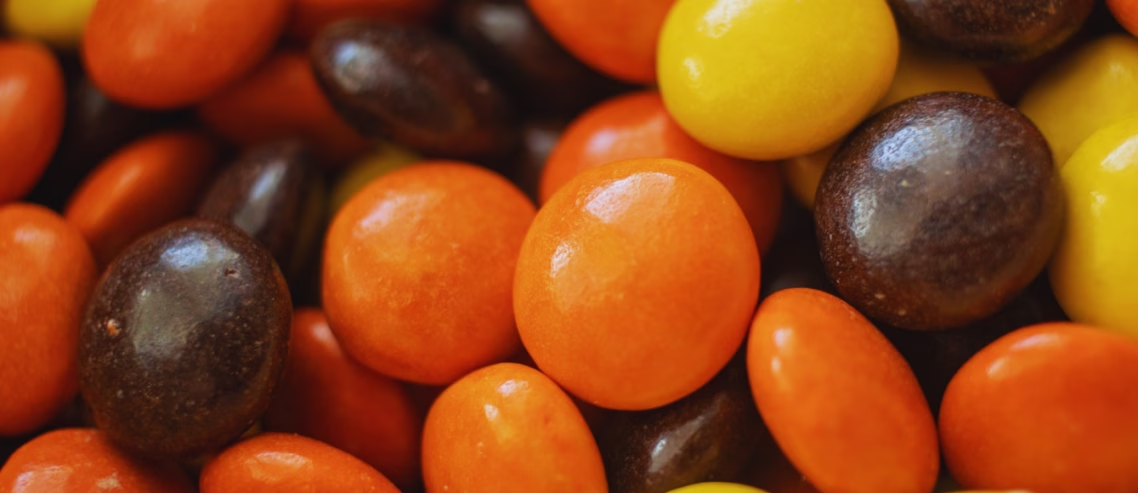
For most Americans, Reese’s Pieces are just a movie theater staple. For the kosher-observant community, the news that just dropped is something of a small miracle: the beloved peanut-butter candy has officially become pareve.
OU Kosher announced on March 12, 2026, that Reese’s Pieces Peanut Butter Candy is no longer classified as dairy. The change was driven by Hershey itself, which reformulated the product, removing dairy ingredients entirely, reportedly in response to consumer demand from the growing non-dairy market. Once Hershey made the switch, the path to OU Pareve certification followed naturally.
What Actually Changed
The Hershey Company decided on its own to strip dairy from Reese’s Pieces. According to OU Kosher’s Chief Operating Officer, Rabbi Moshe Elefant, as reported by The Forward, Hershey recognized that a significant portion of its consumers were uncomfortable with a dairy designation, and once the dairy was gone, OU Pareve status was on the table. The product isn’t merely made without milk ingredients; it’s not even produced on dairy equipment, making it fully pareve under Jewish kosher law.
There is one important catch for now: some packaging still bears the OU-D symbol, a remnant of the old formulation that Hershey won’t be able to update across its supply chain until later in 2026. The OU’s advisory effectively instructs consumers to disregard that label for the time being. The simple verification rule: flip the bag and check the ingredient list or allergen statement. If milk is not listed, the product is pareve regardless of what the symbol says.
It is also worth noting that this change applies specifically to Reese’s Pieces. Reese’s Peanut Butter Cups and other products in the Reese’s line remain dairy and are unaffected by the reformulation.
Why This Matters for the Kosher Community
The kashrut implications here are substantial, and they play out in a few distinct ways.
Meat and dairy separation. Jewish law prohibits consuming meat and dairy together, and, critically, requires a waiting period after eating meat before dairy may be consumed. The length of that waiting period varies by community custom, with many Ashkenazic Jews following a six-hour wait and others observing varying degrees less. For kosher observant consumers, this means that any dairy product is simply off the table for a significant stretch of time after a meat meal. Reese’s Pieces, previously dairy, were caught in this restriction. Now they are not. You can have a steak dinner and reach for a handful of Reese’s Pieces right after without any kashrut concern.
The practical ripple effect is real. Think about Shabbat, where Friday night and Shabbat lunch are almost always fleishig (meat-based) meals. Finding quality pareve dessert options that feel indulgent rather than like a consolation prize is a perennial challenge. Reese’s Pieces, portable, crowd-pleasing, and now fully pareve, slide neatly into that gap.
Cholov Yisroel observance. Beyond the meat-and-dairy issue, the pareve designation also opens the door for Jews who observe cholov yisroel standards, the requirement that all milk used in food production be under Jewish supervision from the point of milking. Because the old Reese’s Pieces contained non-cholov-yisroel dairy, they were off limits for this population entirely. With dairy removed from the formulation, that restriction evaporates. Cholov Yisroel observers can now enjoy Reese’s Pieces freely.
The baking angle. Pareve candy that tastes as if it could pass for dairy-adjacent is genuinely useful in a kosher kitchen. Reese’s Pieces now join the (admittedly short) list of pareve mix-ins that can be used in desserts served after meat meals, a category previously dominated by certain pareve chocolate chips and a handful of other options. Whether they become a staple in pareve cookies, brownies, or ice cream toppings remains to be seen, but the possibility is now open.
A Win for the Non-Dairy World Too
The story doesn’t begin and end with kashrut. The non-dairy food movement has grown dramatically, and it was that broader consumer pressure that prompted Hershey to reformulate in the first place. For lactose-intolerant candy lovers, vegans, and anyone else who avoids dairy for health or ethical reasons, Reese’s Pieces just became a viable option they may have long avoided.
The reaction on OU Kosher’s Instagram captured the mood well, with comments ranging from jubilation over a win for “non-dairy queens” to one commenter declaring it proof that God loves them. That’s the kind of response you get when a change is genuinely meaningful to people’s daily food lives.
A Note of Historical Perspective
OU Kosher’s Rabbi Elefant compared the excitement surrounding this change to the moment when Oreos became kosher in the late 1990s, when the cookies transitioned away from animal fat. That’s not a small comparison. Oreos becoming kosher was a watershed moment for the American kosher consumer, the kind of mainstream product availability that signaled how seriously the food industry had come to take the kosher market.
Whether Reese’s Pieces going pareve rises to that level of significance remains to be seen. But the underlying dynamic is the same: a major American candy brand making a formulation change that, almost as a byproduct, dramatically expands access for kosher-observant and non-dairy consumers alike.
