
 in Opinion
The Kosher Paradox: When “Heimishe” Doesn’t Mean Healthier
An inconvenient truth about ingredient quality in the kosher marketplace
There’s an uncomfortable irony unfolding in the kosher food industry that deserves our attention. Many of us have grown up with a simple equation in our minds: heimishe brands equal better choices for Jewish families. These are “our” companies, often founded by observant Jews, marketed directly to the frum community, and found in every kosher grocery from Brooklyn to Lakewood to Los Angeles. We trust them almost instinctively.
But when you turn over the package and actually read the ingredient list, that trust deserves a second look.
The Ingredient Reality Check
Walk down the aisles of any kosher supermarket and conduct a simple experiment. Compare the ingredient panels of products from well-known heimishe brands, the ones with Hebrew on the packaging, the ones that sponsor our children’s schools and advertise in our community publications, with their counterparts from mainstream companies that happen to offer kosher-certified lines.
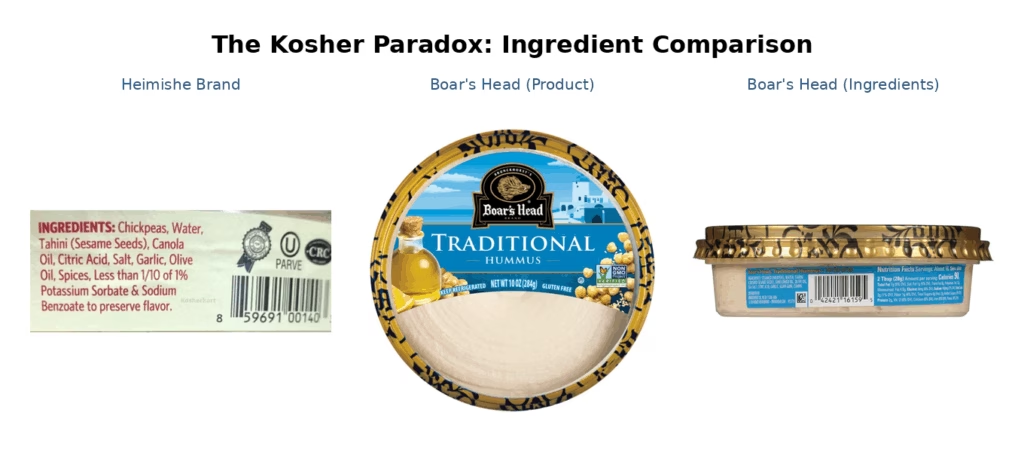
What you’ll often find is striking: the brands we don’t typically associate with kosher living, companies whose main product lines include pork and other non-kosher items, frequently produce kosher-certified products with cleaner, simpler ingredient lists. Their hummus contains chickpeas, tahini, lemon juice, and garlic. Meanwhile, the heimishe version on the shelf above might include a roster of preservatives, artificial flavors, and ingredients you need a chemistry degree to pronounce. Consider hummus as just one example. A popular heimishe brand lists potassium sorbate and sodium benzoate as preservatives. Meanwhile, a mainstream company best known for its deli meats, including products that would never enter a kosher home, produces a kosher-certified hummus with a notably cleaner ingredient panel.
This isn’t a universal truth, and there are certainly exceptions in both directions. But the pattern appears often enough to raise important questions about our assumptions and our marketplace.
The Trust Factor vs. The Label
The paradox runs deeper than ingredients. It touches on something fundamental about how we make purchasing decisions as kosher consumers.
For decades, heimishe brands have built their reputation on being “one of us.” They understand our community. They know what we need for Shabbos and Yom Tov. They advertise in our newspapers and support our institutions. This cultural affinity creates a powerful trust, one that often means we don’t scrutinize their products the way we might scrutinize those from the outside.
Meanwhile, the mainstream companies entering the kosher market with specific product lines face an entirely different dynamic. They’re newcomers trying to earn our business. They often compete by offering products that align with broader health and wellness trends—organic, non-GMO, minimal processing, clean labels. These aren’t necessarily Jewish values they’re responding to, but rather general consumer demand. Yet we benefit from it.
Why Does This Happen?
The reasons behind this paradox are complex and don’t necessarily reflect ill intent from heimishe brands.
Shelf Stability and Distribution: Many heimishe brands grew out of small operations that needed to ensure products could survive distribution networks built for the kosher community, which might mean longer shelf life or time in warehouses. Preservatives became essential to the business model.
Price Sensitivity: The frum community, with larger families and tight budgets, has historically been extremely price-conscious. Using less expensive ingredients and shelf-stable formulations helped keep prices down.
Legacy Formulations: Some of these companies have been using the same recipes for decades. They’ve built customer loyalty on specific tastes and textures, making reformulation risky even as consumer preferences shift.
Different Market Pressures: Mainstream companies entering the kosher market in recent years are responding to a broader consumer base that actively demands clean labels, organic options, and transparency. They’ve already invested in these formulations for their general product lines.
What This Means for Us
None of this is meant to suggest we should abandon heimishe brands or that mainstream kosher-certified products are automatically superior. But it should prompt us to think more carefully about our choices.
We can’t equate “heimishe” with “healthy” by default. Jewish-owned doesn’t mean better ingredients. A hechsher guarantees kashrus, not nutritional quality.
Reading labels matters more than brand loyalty. Whether a company sponsors our local day school or manufactures bacon for its main product line tells us nothing about whether its hummus contains potassium sorbate.
We have power as consumers. If enough of us start choosing products based on ingredient quality and not just cultural comfort, heimishe brands will respond. Many already are, and you can increasingly find clean-label options from companies deeply rooted in the frum world. But the change will accelerate if we demand it with our wallets.
A Call for Evolution, Not Rejection
This isn’t about rejecting our community’s businesses or embracing companies whose core product lines exist far outside our dietary laws. Rather, it’s about recognizing that kashrus and healthfulness are two separate considerations, and we need to be intentional about both.
Our heimishe brands have served our community well for generations. They’ve made kosher food accessible, affordable, and widely available. But as our awareness of nutrition, additives, and ingredient quality has grown, these companies need to evolve alongside us.
Some already are. Others will follow if we show them that clean ingredients matter to us—that we’ll choose the product with five ingredients we recognize over the one with fifteen we don’t, regardless of which aisle it’s stocked in.
The goal isn’t to abandon our community’s businesses but to encourage them to be the best version of themselves, companies that earn our loyalty not just through cultural affinity, but through the genuine quality of what they put in the package.
Because at the end of the day, the most heimishe thing we can do is take care of our families’ health with the same intentionality we apply to keeping kosher. And that means reading the label, every time.
What’s your experience with ingredient quality in kosher products? Have you noticed this paradox in your own shopping? Share your thoughts respectfully in the comments below.

Comments
Comments are disabled for this post